
Intelligent Robot Tennis Training based on YOLO
Keywords:
yolo, Image Processing, Python Programming, Object Detection, Arduino UNOAbstract
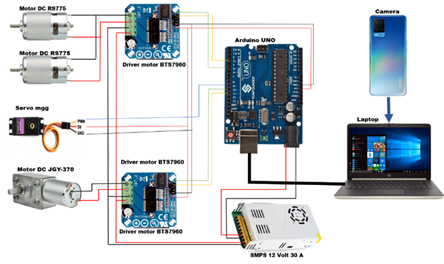
Technological developments worldwide have had a significant impact on various aspects of life, including sports. One of the most popular sports is tennis. However, the use of technology in sports training is still limited, especially in the implementation of automated systems that can improve the efficiency and effectiveness of athlete training. Therefore, in this study, a smart tennis ball launcher based on You Only Look Once (YOLO) as an image processing technology was designed. This tool aims to provide new innovations in athlete training, while also assisting coaches in developing more effective training programs. This system uses several hardware components such as Arduino UNO, DC Motor, Servo Motor MG995, Driver BTS7960, and a camera as the main sensor. Meanwhile, the software used includes Arduino IDE to control the hardware, and Visual Studio Code with the Python programming language to implement the YOLO algorithm in detecting player positions. The results of this study show that the device is able to launch tennis balls to four predetermined areas of the court, according to the player's position detected by the camera. Thus, this tool can be an automated solution in more accurate and efficient tennis training.
Downloads
References
[1] P. Aversa, T. P. Moliterno, K. W. Rockmann, M. S. Bothner, D. Sharapov, and R. Eckardt, “EXPLORING NEW PLAYING FIELDS: SPORTS SETTINGS AND MANAGEMENT THEORIZING,” Acad. Manag. Discov., vol. 11, no. 2, pp. 145–151, 2025,, doi: https://doi.org/10.5465/amd.2025.0064
[2] Y. Zhu, D. Liu, Z. Gao, and Q. Zhong, “Intelligent sports interactive monitoring system based on self-driven sensing-augmented reality fusion,” Appl. Phys. Lett., vol. 126, no. 26, 2025, doi: https://doi.org/10.1063/5.0276388
[3] Y. Zheng, L. Mo, and Z. Ye, “A Robust Multi-Dimensional n-Valued Refined Neutrosophic Logic Framework for Competitive Calculation in the Leisure Sports Industry,” Neutrosophic Sets Syst., vol. 86, pp. 631–643, 2025, doi: 10.5281/zenodo.15514495.
[4] J. Padulo, “Sport and health science: Interdisciplinary approaches to modern challenges,” Br. Med. Bull., vol. 155, no. 1, 2025, doi: https://doi.org/10.1093/b¬mb/ldaf007
[5] E. Glebova, M. Desbordes, and O. Czegledi, “The ‘Clockwork’ Model for Deployment Technology Innovations in Sports Industry Ecosystem: Holistic Approach,” Societies, vol. 14, no. 2, 2024, doi: https://doi.org/10.3390/soc14020023
[6] Y. Zhong, “Enhancing game outcome prediction in the Chinese basketball league through a machine learning framework based on performance data,” Sci. Rep., vol. 15, no. 1, 2025, doi: https://doi.org/10.1038/s41598-025-08882-7
[7] X. Hu, Y. Mao, G. Wang, Q. Li, J. Zhang, and Y. Ji, “Catching spinning table tennis balls in simulation with end-to-end Curriculum Reinforcement Learning,” Eng. Appl. Artif. Intell., vol. 158, 2025, doi: https://doi.org/10.1016/j.engappai.2025.111285
[8] S. Mohottala, A. Gawesha, D. Kasthurirathna, P. Samarasinghe, and C. Abhayaratne, “Spatio-temporal graph neural network based child action recognition using data-efficient methods: A systematic analysis,” Comput. Vis. Image Underst., vol. 259, 2025, doi: 10.1016/j.cviu.2025.104410.
https://doi.org/10.1016/j.cviu.2025.104410
[9] P. Pietraszewski et al., “The Role of Artificial Intelligence in Sports Analytics: A Systematic Review and Meta-Analysis of Performance Trends,” Appl. Sci., vol. 15, no. 13, 2025, doi: https://doi.org/10.3390/app15137254
[10] P. Gong and X. Luo, “A Survey of Video Action Recognition Based on Deep Learning,” Knowledge-Based Syst., vol. 320, 2025, doi: https://doi.org/10.1016/j.knosys.2025.113594
[11] Y. Chen, J. Guo, C. Hao, and C. Song, “Multi-Source Data Fusion Method Research on the Reconstruction and Expansion Project of Long-Line Expressway,” Teh. Vjesn., vol. 32, no. 1, pp. 149–156, 2025, doi: https://doi.org/10.17559/TV-20240424001492
[12] R. M. Sharma, “Artificial intelligence in medical image analysis and molecular diagnostics: recent advances and applications,” J. Med. Artif. Intell., vol. 8, 2025, doi: https://doi.org/10.21037/jmai-24-412
[13] E. Shvartz, O. Zur, L. Attal, Z. Nujeidat, G. Plopsky, and D. Bahir, “GPT-4o vs. residency exams in ophthalmology—a performance analysis,” J. Med. Artif. Intell., vol. 8, 2025, doi: https://doi.org/10.21037/jmai-24-269
[14] S. Katreddi, A. Midatani, A. P. Roy, U. Velpuri, and S. Kasani, “Pediatric pneumonia X-ray image classification: predictive model development with DenseNet-169 transfer learning,” J. Med. Artif. Intell., vol. 8, 2025, doi https://doi.org/10.21037/jmai-24-356
[15] Z. Ding et al., “Innovative design of Ag-based braze alloy and composites for dissimilar joints: Strategies and prospects,” J. Mater. Sci. Technol., vol. 239, pp. 180–194, 2025, doi: https://doi.org/10.1016/j.jmst.2025.04.006
[16] A. R. Singh, S. Athisayamani, F. K. Karim, A. Z. Ibrahim, S. Alshetewi, and S. M. Mostafa, “An enhanced denoising system for mammogram images using deep transformer model with fusion of local and global features,” Sci. Rep., vol. 15, no. 1, 2025, doi: https://doi.org/10.1038/s41598-025-89451-w
[17] S. Prabakaran and S. M. Praveena, “Improved gated recurrent unit-based osteosarcoma prediction on histology images: a meta-heuristic-oriented optimization concept,” Sci. Rep., vol. 15, no. 1, 2025, doi:https://doi.org/10.1038/s41598-025-85149-1
[18] Q. Gong, X. Liu, and Y. Ma, “Real-Time Facial Expression Recognition Based on Image Processing in Virtual Reality,” Int. J. Comput. Intell. Syst., vol. 18, no. 1, 2025, doi: https://doi.org/10.1007/s44196-024-00729-9
[19] P. Pitchandi and R. K. Grace, “An optimal document clustering method using hybrid optimal feature selection and efficient soft computing classifier,” Expert Syst. Appl., vol. 294, 2025, doi: https://doi.org/10.1016/j.eswa.2025.128762
[20] F. Ying, Z. Yanwei, L. Xi, Y. Peidong, and B. Miao, “Improvements in automatic diagnosis methods for knee osteoarthritis based on deep learning,” Chinese J. Tissue Eng. Res., vol. 29, no. 35, pp. 7511–7518, 2025, doi: 10.12307/2026.533.
[21] G. Chen, Y. Zhang, Z. He, and Y. Huang, “Nighttime airport runway FOD intrusive detection through frequency-domain interference of spatially aggregated dynamic feature,” Expert Syst. Appl., vol. 294, 2025, doi: https://doi.org/10.1016/j.eswa.2025.128719
[22] V. Dachepalli and S. Gavini, “A Virtually assisted digital twin enabled object detection in smart industrial manufacturing,” Expert Syst. Appl., vol. 294, 2025, doi: https://doi.org/10.1016/j.eswa.2025.128574
[23] G. Liu, C. Jin, Y. Ni, T. Yang, and Z. Liu, “UCIW-YOLO: Multi-category and high-precision obstacle detection model for agricultural machinery in unstructured farmland environments,” Expert Syst. Appl., vol. 294, 2025, doi: https://doi.org/10.1016/j.eswa.2025.128686
[24] H. Dao Viet et al., “Validation of YOLOv8 algorithm in detecting colon polyps in endoscopy videos,” J. Med. Artif. Intell., vol. 8, 2025, doi: https://doi.org/10.21037/jmai-24-338
[25] H. Tong, D. Zhu, H. Guo, and Z. Zhang, “Adaptive GLMB filter with IoU-based birth modeling for UAV visual multi-object tracking,” Signal Processing, vol. 237, 2025, doi: https://doi.org/10.1016/j.sigpro.2025.110087
[26] Q. Li and W. Chen, “Lightweight vision transformer model for pine wilt disease detection using aerial RGB image and adversarial data augmentation,” Smart Agric. Technol., vol. 12, 2025, doi: https://doi.org/10.1016/j.atech.2025.101167
[27] L. Qiao, M. Veltrup, and B. Mayer, “Comparison of mask R-CNN and YOLOv8-seg for improved monitoring of the PCB surface during laser cleaning,” Sci. Rep., vol. 15, no. 1, 2025, doi: https://doi.org/10.1038/s41598-025-02131-7
[28] G. Liu et al., “A weakly-supervised follicle segmentation method in ultrasound images,” Sci. Rep., vol. 15, no. 1, 2025, doi :https://doi.org/10.1038/s41598-025-95957-0
[29] W. Mansouri, M. A. Alohali, H. Alqahtani, N. Alruwais, M. Alshammeri, and A. Mahmud, “Deep convolutional neural network-based enhanced crowd density monitoring for intelligent urban planning on smart cities,” Sci. Rep., vol. 15, no. 1, 2025, doi: :https://doi.org/10.1038/s41598-025-90430-4
[30] Y. Li, X. Li, and M. Lin, “FE-YOLO: Fourier enhancement YOLO for end-to-end object detection in low-light conditions,” Digit. Signal Process. A Rev. J., vol. 166, 2025, doi: https://doi.org/10.1016/j.dsp.2025.105355
[31] D. L. Tukeev, O. V Afanaseva, and T. F. Tulyakov, “Realization of Statistical Models Based on Symmetric Unimodal Distributions,” Int. J. Eng. Trans. B Appl., vol. 39, no. 6, pp. 407–419, 2026, doi: https://doi.org/10.5829/ije.2026.39.02b.10
[32] O. O. Okundalaye, N. Özdemir, and R. O. Awonusika, “Early breast cancer prediction using optimized machine learning and tumor-immune modeling,” J. Comput. Appl. Math., vol. 473, 2026, doi: https://doi.org/10.1016/j.cam.2025.116875
[33] M. Braun and O. Ezenwachukwu, “Three dimensional calculations of the ground state energy for the electronic wave function of the Coulomb two centre problem using basis functions related to the sinc function,” J. Comput. Appl. Math., vol. 473, 2026, doi:
https://doi.org/10.1016/j.cam.2025.116779
[34] M. Bastam, D. Hashem Majeed, and M. Babagoli, “A Hybrid Ensemble Framework for Smart Irrigation: Optimizing Water Management in Precision Agriculture,” Int. J. Eng. Trans. B Appl., vol. 39, no. 3, pp. 705–726, 2026, doi: https://doi.org/10.5829/ije.2026.39.03c.12
[35] A. Mahdi and A. Al Saadi, “Deep Learning- based Smart Traffic Prediction for Enhanced Quality of Service in Software-defined Networking,” Int. J. Eng. Trans. B Appl., vol. 39, no. 3, pp. 739–755, 2026, doi: https://doi.org/10.5829/ije.2026.39.03c.14
[36] H. M. U. Ali, Q. Farooq, A. Imran, and K. El Hindi, “A systematic literature review on sentiment analysis techniques, challenges, and future trends,” Knowl. Inf. Syst., vol. 67, no. 5, pp. 3967–4034, 2025, doi: https://doi.org/10.1007/s10115-025-02365-x
[37] A. Kabir, S. Wang, Y. Tian, T.-H. Chen, M. Asaduzzaman, and W. Zhang, “ZS4C: Zero-Shot Synthesis of Compilable Code for Incomplete Code Snippets Using LLMs,” ACM Trans. Softw. Eng. Methodol., vol. 34, no. 4, 2025, doi: https://doi.org/10.1145/3702979
[38] B. Casey, J. C. S. Santos, and G. Perry, “A Survey of Source Code Representations for Machine Learning-Based Cybersecurity Tasks,” ACM Comput. Surv., vol. 57, no. 8, 2025, doi: https://doi.org/10.1145/3721977
[39] J. S. Notland, M. Nowostawski, and J. Li, “An Empirical Study on Governance in Bitcoin’s Consensus Evolution,” ACM Trans. Softw. Eng. Methodol., vol. 34, no. 3, 2025, doi: https://doi.org/10.1145/3699600
[40] D. Palla and A. Slaby, “Evaluation of Generative AI Models in Python Code Generation: A Comparative Study,” IEEE Access, vol. 13, pp. 65334–65347, 2025, doi: https://doi.org/10.1109/ACCESS.2025.3560244
[41] S. Pastore et al., “ClearFinder: a Python GUI for annotating cells in cleared mouse brain,” BMC Bioinformatics, vol. 26, no. 1, 2025, doi:
https://doi.org/10.1186/s12859-025-06039-x
[42] D. Swanlund and N. Schuurman, “MaskMyPy: python tools for performing and analyzing geographic masks,” Int. J. Health Geogr., vol. 24, no. 1, 2025, doi: https://doi.org/10.1186/s12942-025-00399-6
[43] A. Ghimire, Y. S. Chung, S. Jeong, and Y. Kim, “Python algorithm package for automated Estimation of major legume root traits using two dimensional images,” Sci. Rep., vol. 15, no. 1, 2025, doi: https://doi.org/10.1038/s41598-025-91993-y
[44] H. Qin, M. Hussain, M. F. Hanif, M. K. Siddiqui, Z. Hussain, and M. A. Fiidow, “On QSPR analysis of pulmonary cancer drugs using python-driven topological modeling,” Sci. Rep., vol. 15, no. 1, 2025, doi: https://doi.org/10.1038/s41598-025-88419-0
[45] P. M. A. Sadique and R. V Aswiga, “Automatic summarization of cooking videos using transfer learning and transformer-based models,” Discov. Artif. Intell., vol. 5, no. 1, p. 7, 2025, doi:https://doi.org/10.1007/s44163-025-00230-y
[46] N. H. Sabbry and A. Levina, “An optimized elliptic curve digital signature strategy for resource-constrained devices,” Sci. Rep., vol. 15, no. 1, 2025, doi: https://doi.org/10.1038/s41598-025-05601-0
[47] H. Guo et al., “Global trends and evolution of aquavoltaics in sustainable aquaculture and energy generation,” Renew. Energy, vol. 255, 2025, doi: https://doi.org/10.1016/j.renene.2025.123864
[48] V.-F. Drăgoi, B. Colombier, N. Vallet, P.-L. Cayrel, and V. Grosso, “Full Key-Recovery Cubic-Time Template Attack on Classic McEliece Decapsulation,” IACR Trans. Cryptogr. Hardw. Embed. Syst., vol. 2025, no. 1, pp. 367–391, 2025, doi: https://doi.org/10.46586/tches.v2025.i1.367-391
[49] A. Kurian, A. Dubey, F. Yaman, and A. Aysu, “TPUXtract: An Exhaustive Hyperparameter Extraction Framework,” IACR Trans. Cryptogr. Hardw. Embed. Syst., vol. 2025, no. 1, pp. 78–103, 2025, doi: https://doi.org/10.46586/tches.v2025.i1.78-103
[50] T. King, Y. Zhou, T. Röddiger, and M. Beigl, “MicroNAS for memory and latency constrained hardware aware neural architecture search in time series classification on microcontrollers,” Sci. Rep., vol. 15, no. 1, 2025, doi: https://doi.org/10.1038/s41598-025-90764-z
[51] Y. Lu, T. Huang, J. Zhang, X. Wang, and X. Guo, “Adaptive finite-time fuzzy prescribed performance fault-tolerant control for uncertain active suspensions with actuator nonlinear characteristics,” J. Sound Vib., vol. 618, 2025, doi: https://doi.org/10.1016/j.jsv.2025.119232
[52] R. Asnawi et al., “Fuzzy Logic Controller-Proportional-Integral for Motor Velocity Control of Electric Rail Train Using DC-DC Converter,” J. Adv. Res. Appl. Sci. Eng. Technol., vol. 54, no. 1, pp. 62–79, 2025, doi: https://doi.org/10.37934/araset.54.1.6279
[53] M. A. Bhayo et al., “High precision experimentally validated adaptive neuro fuzzy inference system controller for DC motor drive system,” Sci. Rep., vol. 15, no. 1, 2025, doi: https://doi.org/10.1038/s41598-025-97549-4
[54] X. Li, Y. Zhang, and J. Wu, “Optimization of tangential interior brushless DC motor rotor for hybrid vehicles,” Sci. Rep., vol. 15, no. 1, 2025, doi:
https://doi.org/10.1038/s41598-025-98799-y
[55] M. A. Khan, D.-E.-Z. Baig, H. Ali, and F. R. Albogamy, “Optimized System Identification (SI) of Brushless DC (BLDC) motor using Data-Driven Modeling Methods,” Sci. Rep., vol. 15, no. 1, 2025, doi: https://doi.org/10.1038/s41598-025-93444-0
[56] B. Meenakshi, J. C. Lavanya, and R. Sivaprasad, “Versa Watt Pioneering a Multi-Output SMPS Solution for Next-Gen Devices,” in 2025 International Conference on Computing and Communication Technologies (ICCCT), IEEE, 2025, pp. 1–4. .https://doi.org/10.1109/ICCCT63501.2025.11019084
[57] F. Hashemzadeh, V. Mohammadi, and M. Sabahi, “Hybrid Control of Bidirectional DC-DC Power Source of Electric Vehicles With Dynamical Brake,” in 2025 IEEE 19th International Conference on Compatibility, Power Electronics and Power Engineering (CPE-POWERENG), IEEE, 2025, pp. 1–6. .https://doi.org/10.1109/CPE-POWERENG63314.2025.11027231
[58] S. Kumar, S. Mondal, A. B. Choudhury, H. S. Bhattacharyya, and C. K. Chanda, “Estimation of state of charge for a lithium-ion battery pack using nonlinear Kalman filters,” Ionics (Kiel)., pp. 1–16, 2025. .https://doi.org/10.1007/s11581-025-06420-z
[59] S. Nau, J. Krummenauer, and A. Zimmermann, “SPICEAssistant: LLM using SPICE Simulation Tools for Schematic Design of Switched-Mode Power Supplies,” arXiv Prepr. arXiv2507.10639, 2025.
[60] M.-S. Kim, J.-W. Sung, Y.-H. Kim, S.-S. Kwak, and S.-D. Choi, “Dual-Band-Based Moving Z-Score Algorithm for Detecting Series AC Arc Faults,” J. Electr. Eng. Technol., pp. 1–13, 2025. https://doi.org/10.1007/s42835-025-02203-8
Downloads
Published
Issue
Section
License
Copyright (c) 2025 Hafid Al’azzah (Author)

This work is licensed under a Creative Commons Attribution-ShareAlike 4.0 International License.


