
Classifier-Chain SVM for TAM-Driven Multilabel Sentiment Analysis in Large-Scale User Acceptance Evaluation
Keywords:
Sentiment Analysis, Multilable Classification, Support Vector Machine, Technology Acceptance Model, Video Editing ApplicationAbstract
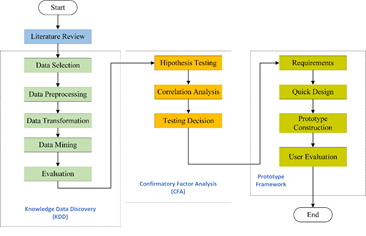
In this work we suggest an alternative and novel integrated method which combines TAM with multilabel sentiment analysis by a SVM classifier. In contrast to literature on traditional TAM research that often comprises survey-based measures, this study utilises user-generated comments written in large numbers as a close substitute factor for perceived usefulness, perceived ease of use, attitude and behavioural intention. A set of 22,366 reviews were harvested from the Google Play Store for the video-editing application CapCut and handled within the Knowledge Discovery in Databases (KDD) framework that comprised data selection, preprocessing, labeling, transformation, mining and evaluation. It was observed that the multilabel SVM model trains 80% of Corpus19 and tested on remaining 20% achieves F1-score: 0.95 (Train) and 0.91 (Test). Stronger associations between both Perceived Usefulness and Perceived Ease of Use, and Attitude Toward Using (r = 0.912, 0.816 respectively) were again shown by Pearson correlation analysis. Meanwhile, Attitude Toward Using was positively related to Behavioral Intention of Use (r = 0.510). These results suggest that the TAM dimensions of comments can be efficiently modeled as multilabel sentiments, and usefulness and ease of use continue to play a significant role in shaping user acceptance towards CapCut
References
[1] N. Patel, L. P. Ramisetty, A. S. Parmar, J. Li, and Y. Zhang, “4EV: Adaptive Video Editing with Spatial Temporal Dynamics and Motion Pathways,” IEEE Access, 2025, doi: 10.1109/ACCESS.2025.3624055.
[2] J. K. Adarsh, V. T. Sreedevi, and D. Thangavelusamy, “Product Review System With BERT for Sentiment Analysis and Implementation of Administrative Privileges on Node-RED,” IEEE Access, vol. 11, pp. 65968–65976, 2023, doi: 10.1109/ACCESS.2023.3275738.
[3] P. Silva, “Davis’ Technology Acceptance Model (TAM) (1989),” in Information Seeking Behavior and Technology Adoption: Theories and Trends, 2015. doi: 10.4018/978-1-4666-8156-9.ch013.
[4] L. Lun, D. Zetian, T. W. Hoe, X. Juan, D. Jiaxin, and W. Fulai, “Factors Influencing User Intentions on Interactive Websites: Insights from the Technology Acceptance Model,” IEEE Access, vol. 12, pp. 122735–122756, 2024, doi: 10.1109/ACCESS.2024.3437418.
[5] B. Nakisa, F. Ansarizadeh, P. Oommen, and S. Shrestha, “Technology Acceptance Model: A Case Study of Palm Vein Authentication Technology,” IEEE Access, vol. 10, pp. 120436–120449, 2022, doi: 10.1109/ACCESS.2022.3221413.
[6] L. Tobarra, J. M. Haut, R. Hernández, R. Pastor-Vargas, and A. Robles-Gómez, “Analyzing the users’ acceptance of an IoT cloud platform using the UTAUT/TAM model,” IEEE Access, vol. 9, pp. 150004–150020, 2021, doi: 10.1109/ACCESS.2021.3125497.
[7] J. Bai and X. Li, “Chinese Multilabel Short Text Classification Method Based on GAN and Pinyin Embedding,” IEEE Access, vol. 12, pp. 83323–83329, 2024, doi: 10.1109/ACCESS.2024.3412649.
[8] K. I. Gunawan and J. Santoso, “Multilabel Text Classification Menggunakan SVM dan Doc2Vec Classification Pada Dokumen Berita Bahasa Indonesia,” Journal of Information System,Graphics, Hospitality and Technology, vol. 3, no. 01, pp. 29–38, Apr. 2021, doi: 10.37823/insight.v3i01.126.
[9] S. Sayardoost Tabrizi, A. Sabzian, and A. Moeini, “A Hybrid Model for Evaluation of E-Learning User Satisfaction with TAM and ELQ Approach,” International Journal of Information and Communication Technology Research, vol. 16, no. 2, pp. 45–54, Apr. 2024, doi: 10.61186/itrc.16.2.45.
[10] Y. Findawati, D. Purwitasari, and A. B. Raharjo, “Dangerous Speech Classification on Twitter using Multilabel Aspects and Structural Features,” IEEE Access, p. 1, 2025, doi: 10.1109/ACCESS.2025.3627932.
[11] S. M. Alzanin, A. Gumaei, M. A. Haque, and A. Y. Muaad, “An Optimized Arabic Multilabel Text Classification Approach Using Genetic Algorithm and Ensemble Learning,” Applied Sciences (Switzerland), vol. 13, no. 18, 2023, doi: 10.3390/app131810264.
[12] J. Mutinda, W. Mwangi, and G. Okeyo, “Sentiment Analysis of Text Reviews Using Lexicon-Enhanced Bert Embedding (LeBERT) Model with Convolutional Neural Network,” Applied Sciences (Switzerland), vol. 13, no. 3, 2023, doi: 10.3390/app13031445.
[13] Y. Asri, W. N. Suliyanti, D. Kuswardani, M. Fajri, “Pelabelan Otomatis Lexicon Vader dan Klasifikasi Naïve Bayes dalam Menganalisis Sentimen Data Ulasan PLN Mobile,” Jurnal Pengkajian dan Penerapan Teknik Informatika, vol. 15 No. 2, 2022, doi: 10.33322/petir.v15i2.1733.
[14] D. M. Abdullah and A. M. Abdulazeez, “Machine Learning Applications based on SVM Classification: A Review,” Qubahan Academic Journal, vol. Vol.1 No.2, 2021, doi: 10.48161/qaj.v1n2a50.
[15] X. Luo, “Efficient English text classification using selected Machine Learning Techniques,” Alexandria Engineering Journal, vol. 60, no. 3, 2021, doi: 10.1016/j.aej.2021.02.009.
[16] T. Carneiro, R. V. M. Da Nobrega, T. Nepomuceno, G. Bin Bian, V. H. C. De Albuquerque, and P. P. R. Filho, “Performance Analysis of Google Colaboratory as a Tool for Accelerating Deep Learning Applications,” IEEE Access, vol. 6, pp. 61677–61685, 2018, doi: 10.1109/ACCESS.2018.2874767.
[17] Y. Wang, W. Meijer, J. Antonio Hernández López, U. Nilsson, and D. Varró, “Why Do Machine Learning Notebooks Crash? An Empirical Study on Public Python Jupyter Notebooks,” IEEE Transactions on Software Engineering, vol. 51, no. 7, pp. 2181–2196, 2025, doi: 10.1109/TSE.2025.3574500.
[18] M. A. A. Mosleh, A. A. A. Mohammed, E. E. A. Esmail, R. A. A. Mohammed, and B. Almuhaya, “Hybrid Deep Learning and Fuzzy Matching for Real-Time Bidirectional Arabic Sign Language Translation: Toward Inclusive Communication Technologies,” IEEE Access, vol. 13, pp. 94118–94136, 2025, doi: 10.1109/ACCESS.2025.3574103.
[19] Y. Akkem, B. S. Kumar, and A. Varanasi, “Streamlit Application for Advanced Ensemble Learning Methods in Crop Recommendation Systems – A Review and Implementation,” Indian J Sci Technol, vol. 16, no. 48, pp. 4688–4702, Dec. 2023, doi: 10.17485/IJST/v16i48.2850.
[20] C. Ahmed, A. ElKorany, and E. ElSayed, “Prediction of customer’s perception in social networks by integrating sentiment analysis and machine learning,” J Intell Inf Syst, vol. 60, no. 3, 2023, doi: 10.1007/s10844-022-00756-y.
[21] V. Umarani, A. Julian, and J. Deepa, “Sentiment Analysis using various Machine Learning and Deep Learning Techniques,” Journal of the Nigerian Society of Physical Sciences, vol. 3, no. 4, 2021, doi: 10.46481/jnsps.2021.308.
[22] A. Samyuktha, M. Pallavi, L. Jagan, D. . Y. Srinivasulu, and Mr. M. Rakesh, “Sentiment Analysis Using Machine Learning,” Int J Res Appl Sci Eng Technol, vol. 11, no. 1, 2023, doi: 10.22214/ijraset.2023.48706.
[23] M. Costola, O. Hinz, M. Nofer, and L. Pelizzon, “Machine learning sentiment analysis, COVID-19 news and stock market reactions,” Res Int Bus Finance, vol. 64, 2023, doi: 10.1016/j.ribaf.2023.101881.
[24] I. C. Obagbuwa, S. Danster, and O. C. Chibaya, “Supervised machine learning models for depression sentiment analysis,” Front Artif Intell, vol. 6, 2023, doi: 10.3389/frai.2023.1230649.
[25] E. Elgeldawi, A. Sayed, A. R. Galal, and A. M. Zaki, “Hyperparameter tuning for machine learning algorithms used for arabic sentiment analysis,” Informatics, vol. 8, no. 4, 2021, doi: 10.3390/informatics8040079.
[26] R. Wijayanti and A. Arisal, “Automatic Indonesian Sentiment Lexicon Curation with Sentiment Valence Tuning for Social Media Sentiment Analysis,” ACM Transactions on Asian and Low-Resource Language Information Processing, vol. 20, no. 1, 2021, doi: 10.1145/3425632.
[27] H. R. Bosker, “Using fuzzy string matching for automated assessment of listener transcripts in speech intelligibility studies,” Behav Res Methods, vol. 53, no. 5, 2021, doi: 10.3758/s13428-021-01542-4.
[28] W. Suwarningsih and N. Nuryani, “Generate fuzzy string-matching to build self attention on Indonesian medical-chatbot,” International Journal of Electrical and Computer Engineering, vol. 14, no. 1, 2024, doi: 10.11591/ijece.v14i1.pp819-829.
[29] W. K. Härdle, D. D. Prastyo, and C. M. Hafner, “Support Vector Machines with Evolutionary Feature Selection for Default Prediction,” SSRN Electronic Journal, 2017, doi: 10.2139/ssrn.2894201.
[30] J. Read, B. Pfahringer, G. Holmes, and E. Frank, “Classifier chains for multi-label classification,” Mach Learn, vol. 85, no. 3, 2011, doi: 10.1007/s10994-011-5256-5.
[31] A. Abdullahi, N. A. Samsudin, S. K. A. Khalid, and Z. A. Othman, “An Improved Multi-label Classifier Chain Method for Automated Text Classification,” International Journal of Advanced Computer Science and Applications, vol. 12, no. 3, 2021, doi: 10.14569/IJACSA.2021.0120352.
Downloads
Published
Issue
Section
License
Copyright (c) 2025 Nafla Aurellia, Wiyli Yustanti, Hanim Maria Astuti (Author)

This work is licensed under a Creative Commons Attribution-ShareAlike 4.0 International License.


