
Domain Generalization Performance of CNN Architectures for Face Anti-Spoofing Using a Multi-Dataset Evaluation
Keywords:
Face Recognition, Face Anti-spoofing, Convolutional Neural Network (CNN), Cross-dataset Evaluation, EfficientNetB0, Fine-tuning, Model GeneralizationAbstract
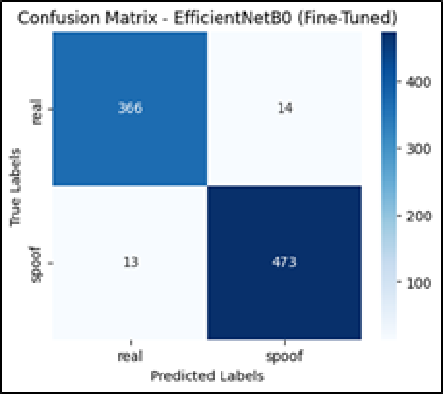
Face recognition is widely used to improve the security level and digital attendance systems, but even still, it can susceptible to the spoofing using photos, videos or fake mask. The objective of this work is to evaluate the generalization performance of three CNN architectures (MobileNetV2, EfficientNetB0 and ResNet50) on face spoof detection by applying them into intra-dataset and cross-dataset experiments with SiW-Mv2, Replay-Attack and Paper-Attack datasets. The working of the deep-learning model is explained along with pre-processing of all datasets: firstly, splitting videos into training, validation and test sets. Secondly, frame extraction Thirdly, data augmentation for the training images; and fourthly Normalization-based preprocess_input method. The models use a fine-tuning method to train on the last 30\% of layers; maximum number of epochs is set at 30, batch size typically is {32},and hyperparameters are fixed. Experimental results are evaluated with respect to accuracy, precision, recall, F1-score, confusion matrix and average drop rate as measure of sensitivity of generalization. This experiment confirms that EfficientNetB0 has the lowest performance loss on all cross-dataset scenarios, therefore being the most stable architecture for domain variations. The adjusted model is fine-tuned by optimization of the learning rate and patience value, which performs better in testing on SiW-Mv2. The chosen model is finally tested on facial recognition based attendance systems to demonstrate practical applicability. The reported results lead to the establishment of more secure attendance systems, with higher robustness and less vulnerability to spoof attacks
References
[1] A. Anshari, S. A. Hirtranusi, D. I. Sensuse, Kautsarina, and R. R. Suryono, “Face Recognition for Identification and Verification in Attendance System: A Systematic Review,” in 10th IEEE International Conference on Communication, Networks and Satellite, Comnetsat 2021 - Proceedings, Institute of Electrical and Electronics Engineers Inc., Jul. 2021, pp. 316–323. doi: 10.1109/COMNETSAT53002.2021.9530817.
[2] P. Anthony, B. Ay, and G. Aydin, “A review of face anti-spoofing methods for face recognition systems,” in 2021 International Conference on INnovations in Intelligent SysTems and Applications, INISTA 2021 - Proceedings, Institute of Electrical and Electronics Engineers Inc., Aug. 2021. doi: 10.1109/INISTA52262.2021.9548404.
[3] Z. Ming, M. Visani, M. M. Luqman, and J. C. Burie, “A survey on anti-spoofing methods for facial recognition with rgb cameras of generic consumer devices,” J Imaging, vol. 6, no. 12, Dec. 2020, doi: 10.3390/jimaging6120139.
[4] Z. Yu, Y. Qin, X. Li, C. Zhao, Z. Lei, and G. Zhao, “Deep Learning for Face Anti-Spoofing: A Survey,” IEEE Trans Pattern Anal Mach Intell, vol. 45, no. 5, pp. 5609–5631, May 2023, doi: 10.1109/TPAMI.2022.3215850.
[5] J. Spencer et al., “Presentation Attack Detection using Convolutional Neural Networks and Local Binary Patterns,” 2023. doi: 10.48550/arXiv.2312.00041.
[6] X. Tu, H. Zhang, M. Xie, Y. Luo, Y. Zhang, and Z. Ma, “Deep Transfer Across Domains for Face Anti-spoofing,” Dec. 2019, doi: 10.1117/1.JEI.28.4.043001.
[7] H. Xing, S. Y. Tan, F. Qamar, and Y. Jiao, “Face Anti-Spoofing Based on Deep Learning: A Comprehensive Survey,” Applied Sciences (Switzerland), vol. 15, no. 12, Jun. 2025, doi: 10.3390/app15126891.
[8] N. Surantha and B. Sugijakko, “Lightweight face recognition-based portable attendance system with liveness detection,” Internet of Things (Netherlands), vol. 25, Apr. 2024, doi: 10.1016/j.iot.2024.101089.
[9] D. Saraswat, P. Bhattacharya, T. Shah, R. Satani, and S. Tanwar, “Anti-spoofing-enabled Contactless Attendance Monitoring System in the COVID-19 Pandemic,” in Procedia Computer Science, Elsevier B.V., 2022, pp. 1506–1515. doi: 10.1016/j.procs.2023.01.129.
[10] Y. Bian, P. Zhang, J. Wang, C. Wang, and S. Pu, “Learning Multiple Explainable and Generalizable Cues for Face Anti-spoofing,” Feb. 2022, doi: 10.48550/arXiv.2202.10187.
[11] Y. Sun, Y. Liu, X. Liu, Y. Li, and W.-S. Chu, “Rethinking Domain Generalization for Face Anti-spoofing: Separability and Alignment,” Mar. 2023, doi: 10.48550/arXiv.2303.13662.
[12] Computer Vision Lab, Michigan State University, “SiW-Mv2 Dataset.” [Online]. Available: https://cvlab.cse.msu.edu/siwm-v2-dataset.html.
[13] X. Guo, Y. Liu, A. Jain, and X. Liu, “Multi-domain Learning for Updating Face Anti-spoofing Models,” Apr. 2023, doi: 10.48550/arXiv.2208.11148.
[14] TrainingDataPro, “Real vs Fake Anti-Spoofing Video Classification Dataset.” [Online]. Available: https://www.kaggle.com/datasets/trainingdatapro/real-vs-fake-anti-spoofing-video-classification
[15] I. Chingovska, A. Anjos, and S. Marcel, “On the Effectiveness of Local Binary Patterns in Face Anti-spoofing,” Proceedings of the 11th International Conference of the Biometrics Special Interes Grou, 2012. [Online]. Available: http://www.idiap.ch/dataset/replayattack.
[16] AxonData, “Face Anti-Spoofing Dataset.” [Online]. Available: https://www.kaggle.com/datasets/axondata/face-anti-spoofing-dataset.
[17] AxonData, “Advanced Paper Attacks Dataset.” [Online]. Available: https://www.kaggle.com/datasets/axondata/face-anti-spoofing-advanced-paper-attacks.
[18] TrainingDataPro, “IBETA Level-1 Liveness Detection Dataset Part 1.” [Online]. Available: https://www.kaggle.com/datasets/trainingdatapro/ibeta-level-1-liveness-detection-dataset-part-1.
[19] TrainingDataPro, “Printout Dataset.” [Online]. Available: https://www.kaggle.com/datasets/trainingdatapro/printout.
[20] TrainingDataPro, “CelebA Spoof Dataset.” [Online]. Available: https://www.kaggle.com/datasets/trainingdatapro/celeba-spoof-dataset.
[21] Tapakah68, “Selfie and Video on Back Camera Dataset.” [Online]. Available: https://www.kaggle.com/datasets/tapakah68/selfie-and-video-on-back-camera
[22] Y. Zhang, Z. Yin, L Y. Li, G. Yin. J. Yan, J. Shao, Z. Liu, “CelebA-Spoof: Large-Scale Face Anti-Spoofing Dataset With Rich Annotations,” in Proc. European Conference on Computer Vision (ECCV), pp. 70–85, 2020, doi: 10.1007/978-3-030-58610-2_5.
Downloads
Published
Issue
Section
License
Copyright (c) 2025 Angel Rica Siceliya (Author)

This work is licensed under a Creative Commons Attribution-ShareAlike 4.0 International License.


